Showing posts with label hiphop. Show all posts

10 January 2009

A Master Class in Signifyin'

99. JAY-Z, "99 Problems"
Produced by Jay-Z & Kareem "Biggs" Burke; written by Shawn Carter, N.Landsberg, Felix Pappalardi, Rick Rubin, Billy Squier, J. Ventura, & L. Weinstein
Def Jam 000248411 2004 Billboard: # 30

Just after this single came out, a friend of mine was scheduled to speak at a conference on Black Masculinity in the Twenty-First Century. I suggested he and the other participants spend the conference taking apart this song.

Let me roll things back a bit to put this in perspective. In 1931, Louis Armstrong recorded "Shine," a song that lists nearly all of the qualities that are supposed to identify the stock Negro of early twentieth century culture. No one would deny that the song itself is deeply racist, a late survival of the worst minstrel show tendencies. The argument comes over what to make of Armstrong's interpretation of the song. Some--especially those who have seen the 1932 film A Rhapsody in Black and Blue, in which Armstrong performs the song in a leopard skin--would argue that his recording perpetuates the worst traits of racism, that one of jazz's great revolutionaries had by 1931 become no more than an Uncle Tom, allowing himself to be seen exactly as racist whites wanted to see him. For me, though, Dooley Wilson's version of the song in Casablanca is much more stereotypical. Wilson may be wearing a suit rather than a leopard skin as he sings it, but his eyes roll all the while, he hangs on the audience's reaction, and his vocal attack on the lyrics wouldn't have been out of character for such turn of the century minstrel legends as Arthur Collins or Byron Harlan.

By contrast, if you open your ears, what Armstrong does with the song is much more radical. He does more than simply "scat" the lyrics--he deconstructs them into smithereens. His vocal and improvisatory skill is so manifest, and the sounds are so chopped up into fragments, that the lyrics almost don't seem to exist anymore. He doesn't inhabit a racist song and allow it to endure. He stomps it into submission until we'll never be able to take the "real" words seriously again.

Jay-Z's performance on "99 Problems" is much the same trick, but it's more a matter of semantics than phonics. He takes one word that he, like many 1990s rappers, has rightfully been accused of overusing and rings a series of changes on it. The word, of course, is bitch, and if you don't think HOVA ever used it too casually, listen to 1998's "Can I Get a ---?" again (even though that track does technically give women equal time to complain about their worthless men).

Here, though, that noxious word gives rise to a masterpiece of the genre. Listening to Jay-Z on this record, from his supposed "farewell" album, I think he's not only read the complaints about his language, he's read the conference papers and dissertations about him too. He turns the word on its head, implicitly acknowledging that the concerns that dominate most rap lyrics are relatively trivial. The icing on the cake, of course, is when he takes a verse to brilliantly relate a far-too-typical DWB pullover and ends the cop's spiel with the line We'll just see how you feel when the canines come, taking bitch back in the ensuing chorus to its literal meaning. The drop to the downbeat between that verse and chorus may be my favorite hiphop moment ever.

03 January 2009

One Way to Avoid a Club Fight


598. N.O.R.E. "Nothin'"
Produced by the Neptunes; written by Chad Hugo, Victor Santiago, Jr., & Pharrell Williams
Universal 582914 2002 Billboard: # 10

My best friend insists that "humor can often defuse a tense situation." This worked once for him, when he was at a camp as a kid, and he's used it ever since. In my experience, though, cracking wise in the wrong situation can often get your head cracked open. Usually, when the shields go up, I find it's best to keep my mouth shut.

Then there's N.O.R.E., aka Noreaga aka Victor Santiago Jr., who raps his way out of a club fight on this track, the way only the best of the best can do. On the refrains, Fat Joe sounds as if he is ready to do some very serious damage, but our hero just keeps plowing through. The longer you listen, the more you think, maybe he will talk this guy down. These rhymes aren't threatening or even menacing. They're just . . . distracting, which may be all he needs to slip away without catching it.

He uses everything he's got here, including both sides of his racial heritage. Much was made of the fact that N's next album, N.O.R.E. y la Familia...Ya TĂș Sabe, explicitly drew on reggaeton, but here the influences are mixing it up as much he and Fat Joe aren't.His maternal African American tradition of words is laid here on top of a rhythm track (courtesy of the 'Tunes, of course) that owes more to the Puerto Rican music of his father. It's not a fully integrated musical genre, or even a peace treaty between the two cultures. Musically and thematically, it's just a stab at anything that will work.

Respect the Flow


742. DR. DRE, "Forgot About Dre"
Produced by Dr. Dre; written by Melvin Bradford, Marshall Mathers, and Andre Young
Maverick 17206 1998 Billboard: # 5

Rappers simply can't get respect. I'm not talking about the self-conscious contests for respect that have been the premise of the genre since the 1970s. I'm talking about career respect. If a rocker or pop star enjoys three Top 40 singles, they can tour the oldies circuit for decades after that. But even if a rapper's career begins with two or three best-selling albums, if she or he wants to stay in the business for the long run, there are basically two options: act or produce.

After NWA broke up, Dr. Dre produced and fronted The Chronic, almost certainly the aesthetically finest product that the morally dubious genre of gangsta ever produced. And then . . . he produced, and he produced brilliantly. With a typically uncluttered but still full style of production, his work with Snoop Dogg was cleverer than most listeners appreciated. More important, his achievement in discovering and launching Eminem within the genre was literally unprecedented in pop music. It was as if Sam Phillips had been black; as if hiphop had finally found its Henry Higgins; as if Dre were the Apollo Creed of the genre, training Marshall "Rocky" Mathers to take on a ring full of Clubber Langs.

To give credit where credit is due, Eminem almost consistently presented himself as Dre's sidekick. He does it here too, but it's a little sad that this track--released at almost the height of Em's popularity--leads up to the protegee rather than his producer.

That is unless you think the words are irrelevant, and it's just the tweaking bassline that's the point of the song. But this is rap--is that possible?

Yes, because this isn't quite rap. It's hiphop. Dr. Dre was one of the key figures who irrevocably turned the former genre into the latter. Hiphop selfconsciously embraced funk bass lines like the one employed here, so that flow was no longer just a matter of words. And even if it's Marshall gibber-gabbering the words for much of this track, all the way through the flow is all Andre's.

So forget the star--respect the producer. Respect the flow.

03 June 2008

Awareness Is Not the Same Thing as Attention (Just Ask William James)

138. JAMES & BOBBY PURIFY, "Shake a Tail Feather"
Produced by Papa Don; written by Otha Hayes, Verlie Rice, & Andre Williams
Bell 669 1967 Billboard: # 25

139. QUEEN, "Fat Bottomed Girls"
Produced by Roy Thomas Baker and Queen; written by Brian May
Elektra 45541 1978 Billboard: # 24

140. SIR MIX-A-LOT, "Baby Got Back"
Produced by Rick Rubin; written by Sir Mix-a-Lot
Def American 18947 1992 Billboard: # 1

141. SISQO, "Thong Song"
Produced by Kevin Liles & Sisqo; written by Mark Anderson, Desmond Child, Tim Kelly,Joseph Lango, Bob Robinson, and Robi Rosa
Def Jam 562599 2000 Billboard: # 3

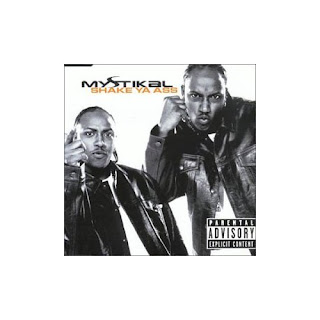
142. MYSTIKAL, "Shake Ya Ass"
Produced by Charles Temple; written by Chad Hugo, Michael Tyler, Pharrell Williams
Jive 42721 2000 Billboard: # 13

A third of a century of B.A. in pop. No, not Bad Attitude. Butt Awareness. I first encountered the term in the early 1990s, although obviously the phenomenon to which it refers predates that era by quite a few years. Still, the early 1990s do seem in retrospect like some sort of crossover moment for popular representations of the posterior--a moment of epistemological emergence, if you will.

Like the other singles listed here, James & Bobby Purify's "Shake a Tail Feather" easily made the Top 40, chiefly on its strength as a dance tune.

The song itself is undistinguished and yet surprisingly durable, with multiple renditions stretching from the Five Du-Tones' original 1963 version to the Cheetah Girls' 2006 cover for the soundtrack of Disney's Chicken Little. The Purifys' version stands out, though, chiefly because of Papa Don's production. It's also worth pointing out, in light of the records considered below, that the reference to the butt here is more metaphorical than strictly anatomical. The singers seem quite happy to just dance in the club with the woman to whom they sing and don't necessarily require anything more from her.

Eleven years after the Purifys' tribute to dance club display, Queen received numerous protests from feminists for their own song's focus on that specific part of the female anatomy. Obviously, the picture sleeve for their double-sided single didn't help, but I've always thought that this song got a bit of a bad rap. It's nowhere near as sexist as the Stones' "Some Girls," which received protests around the same time, and it does provide a bit of a useful corrective about body image. This is a song that exhorts men to broaden their horizons and accept women of all body types. Ain't no beauty queens in this locality, the lyric goes, and it implies that that's a good thing, that widely circulated images of female beauty can desensitize consuming men to the charms of real-life women. If you take the song seriously (which I know may be a patently ridiculous thing to do). it is less about the culturewide objectification of women than about how heterosexual men do and don't visually appreciate the women that they know. Obviously, a man should not assess a woman wholly by her looks, but visual attraction is still an undeniable component of sexuality.
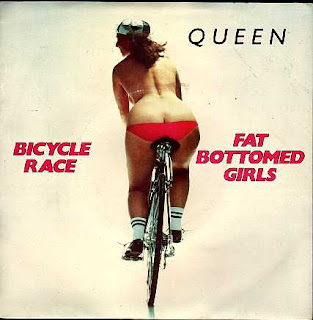
I suspect that this particular issue is more of a heterosexual (or if you insist heterosexist) phenomenon. This song is credited to Queen's lead guitarist Brian May, while its flipside, "Bicycle Race," is credited to the band's frontman Freddie Mercury. Nevertheless, Mercury delivers May's lyric with conviction, striking a blow for broadly conceived definitions of physical beauty everywhere.
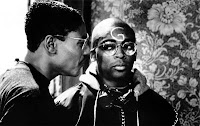

Some of the protest against Queen may have been racially tinged as well. Nine years later when Spike Lee made School Daze, his musical about a historically black college, he received some negative comment for featuring a big dance number baldly titled "Da Butt," but these comments were mostly of the "shande for the goyim" variety: how could you let the ofays see something like that? what will they think?

By the time Sir Mix-a-Lot's "Baby Got Back" came along in 1992, however, Butt Awareness had become an open sign of racial distinctiveness if not downright pride for some African Americans. While it may be arguable whether Queen's single is a self-conscious critique of widely circulated images of female attractiveness, there is no doubt that Sir Mix-a-Lot has his preferred mass culture targets lined up in a row here: Cosmo (too thin), Playboy (too fake), rock videos (too lifeless). The shoutout to Florence Griffith Joyner seems to be a stab at racial bragging, and I've always read the "red beans and rice" line as an attempt by a Seattle-based African American male to self-consciously include his Caribbean sisters in this oddly anatomical pride parade.
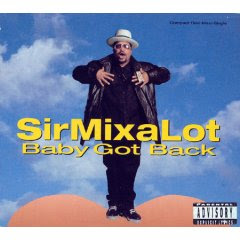
In the end, there is a world of difference between "Baby Got Back" and Mix's 1994 mammary-themed follow-up single "Put 'Em on the Glass." The former song is about appreciating the variety of female beauty, while the latter is simply about a lazily undifferentiated interest in, as Mix grunts repeatedly at one point, "lungs." Nevertheless, it was this latter song that pointed the way to the future, to singles that were more graphic and anatomical than the Purifys' old dance stylings but less personalized than Queen's and Sir Mix-a-Lot's tributes. Viewed side by side, "Thong Song" and "Shake Ya Ass," both released in 2000, give us the twentyfirst century hiphop version of a butt-based madonna/whore complex. Sisqo, liberated from Dru Hill, is now apparently worshipping fulltime in the Temple of the Butt. He chants and keens his adoration but dares not approach his sacred vision--or presumably notice that there is a human being attached to it.

As for Mystikal, don't be fooled by his old school, Cab-Calloway-meets-James-Brown vibe. This song features a scenario that will become all too familiar in 21st century dance and hiphop tracks, a scene on which I've already commented in my brief treatment of crunk. In this song, the singer tells the women to line up and move exactly as he tells them to. As in later "club" singles, the distinction between dance clubs and strip clubs seems blurred, and Mystikal's alternation of direct physical orders and promised material rewards make the epithet "ho" seem all too literal here. The line between appreciation and objectification is crossed in these two songs, more obviously in Mystikal's, more subtly in Sisqo's. The women in question are just body parts here, and the men singing about them don't seem to have even a perfunctory interest in the souls that animate them.
So, over four decades since the Five Du-Tones' original single, we have ended up here: with a variety of culturally provided images against which young men can physically measure the women that they actually know. I don't think that's progress, but it definitely qualifies as some kind of cultural evolution. (Some kind.)

Call me a nut, but I would really like to hearken back to one word in Brian May's easily dismissed lyric for "Fat Bottomed Girls": locality. Locality, specificity, individuality, soul--that's the core of beauty. That's what animates it, physically, romantically, or even purely sexually. And the more heterosexual men measure the varied real women that they know against the stylized icons that pop provides, the more they lose their grasp on their intoxicating souls.

02 June 2008

And the Children Shall Lead


678. LADY SOVEREIGN, "Random"
Produced by Ad-Rock, Ceri Evans, and Medasyn; written by L. Harman & G. Olegavich
Casual 015 2005 Did not make pop charts

679. LIL MAMA, "Lip Gloss"
produced by Famliar Mindz; written by F. Crumm, N. Kirkland, and E. Serrano
Jive 707519 2007 Did not make pop charts

If you buy the myth as presented in the standard histories (and particularly in 8 Mile), hiphop is supposed to be egalitarian. In the myth, anyone can step up to the mike and take their shot. In reality, though, the newest figures in hiphop seem almost as manufactured as the ones in pop.

These two singles, though, are exceptions. Honestly, they're two of my favorite debuts in hiphop ever. Both rappers were barely old enough to vote when they laid down these tracks, and both songs still bear the mark of schoolyard taunts. But if rap really is just an extension of the dozens. just a showdown that's won on pure verbal or rhythmic facility, then these two young women could probably take on most challengers. The soi-disant vertically challenged S-O-V from Chalkhill takes down Chingy, J-Kwon, and Chris Bridges in short order. And my fellow Brooklynite? She takes down the principal, just by wielding (as the original Buffy Summers once referred to her most innate superpower) her keen fashion sense. She poppin.

19 May 2008

Hail to the Fool


912. PUBLIC ENEMY, "911 Is a Joke"
Produced by Carl Ryder, Eric "Vietnam" Sadler, Hans Shocklee, and Keith Shocklee; written by Flavor Flav, Eric "Vietnam" Sadler, and Keith Shocklee
Def Jam 73309 1990 Billboard # 34

Because back in the day, children, Flavor Flav was not a clown--he was a Fool. Cracking wise and speaking truth, here he is in his finest hour, not merely serving as a comic foil for Chuck D but holding the whole single by himself, being seriously funny. Social commentary you can dance to and sing along on the chorus for? That makes the upper half of the Hot 100? Hell yes that's a day that we should feel nostalgic for.

18 May 2008

A Shard of Cultural HoStory


436. LUDACRIS, "Area Codes"
Produced by Ludacris and Chaka Zulu; written by Phalon Alexander, Chris Bridges, N. Hale, and B. Nichols
Def Jam 588671 2001 Billboard # 24

Can you remember when cellphones were the equivalent of Star Trek communicators, when the very fact that Fox Mulder had one in his hand all the time made him one of the most futuristic people on the planet? It almost seems quaint now, doesn't it?

Chris Bridges could obviously learn a little something about speaking respectfully to and about women, but in recording this single he did perform a public service: he captured a very precise moment in time, when cellphones were no longer uncommon but area codes still meant something. Because, seriously, today, does a 617 area code tell you anything about the person you're calling? Only that they were in eastern Massachusetts at some point in their lives. They could be living anywhere now, including down the hall or block from you. Area codes are no longer exotic. They may tell you about someone's past history but not about their current geography. For that, you need to track them using the GPS signature in their phone, and I'm sure some hiphop romantic (MC Jaq Bauer?) is out there right now trying out a series of rhymes on that topic that should be hitting the pop charts in time for the 10th anniversary of Ludacris' national epic.

Not that Cris would be caught dead calling a 617 woman. As one brave soul at cominganarchy.com has demonstrated, his calling patterns hew to a distinct geographical spread:

10 May 2008

Coalition of the Chillin'

568. BEWARE, Panjabi MC ft/Jay-Z
Produced and written by Janjua, Larson, Phillips, and Rai
Sequence 8012 2003 Did not make pop charts.

569. GALANG, M.I.A.
Produced by South Rakkas Crew, written by Maya Arulpragasm, Justine Frischmann, Steve Mackey, & Ross Orton
XL 41199 2003 Did not make pop charts

Bhangra rules! Proof that pop culture is always more complicated than it looks.

2003 was the height of popular American anti-Arabism, anti-Asianism and (let's be honest) anti-"Orientalism." Everything, anything, and anyone south of Russia and west of Laos was suspect in the eyes of most U.S. citizens, so it only makes sense that Sikh backing tracks were the rage that year not in the U.S. but in Tony Blair's Britain. Missy Elliott’s “Get Ur Freak On” had had a slightly similar sound two years before, but in these two cases the toasters had actual roots in the Indian subcontinent. Hip-hop has been top-down global since the late 1980s, but this was one of the few moments when what might formerly have been a local sound traveled into the pop mainstream in a Western country (and the pop underground in the U.S.), rather than having the corporate voice of hip-hop move in the other direction.
The only analogous moment I can think of was thirty years before that, when Manu Dibango’s “Soul Makossa” broke wide in the states.

Both Panjabi MC and MIA are British, of course, no matter what their ancestry. Without the transplanted and transformed cultures of its former colonies and imperial possessions, it’s hard to imagine where British culture would have been in the last quarter century. But what about m’boy HOVA? You could just chalk it up to cultural imperialism and repackaging, to the exoticism of The Other that US culture was trying to seduce/contain in the buildup to the invasion of Iraq, etc., but listen to the American's superimposed flow here. There is at least a pretence to self-conscious global politics. Jay's no Chomsky, but the last time I checked MC Noam's street cred was still sorely lacking.

Dissent was pretty rare stateside in the Shock and Y'Awl world of 2003. In a time and a place where a Sikh was pulled from a train and beaten because idiots thought he was a Muslim, maybe chillin to Panjabi MC was a political act. At least, it was a start. And no, now that you mention it, it don’t stop.

Heavens to Murgatroyd Even (Word)


276. INSANE IN THE BRAIN, Cypress Hill
Produced by Muggs & Chris Schwartz, written by L. Freese & L. Muggerud
Ruffhouse 77135 1993 Billboard: # 19

277. DOIN’ IT, L L Cool J
Produced by Chryskillz, Easy Mo Bee, Chad "Dr. Seuss" Elliott, Jean-Claud Oliver; Rashad Smith; written by LL Cool J
Del Jam 576120 1996 Billboard: # 20

In the 90s, there was a lot of concern about rap and its effect on children, but seriously what could be nicer than this? Bullwinkle and Snagglepuss making their rap debuts. What? That’s not them? This isn’t Jay Ward and Hanna Barbera keeping it real? Oh.