993. PET SHOP BOYS, "Go West"
Produced by Pet Shop Boys and Stephen Hague; written by Henri Belolo, Jacques Morali, and Victor Willis
EMI 58084 1993 Did not make pop charts
. . . because, of course, things do come after.
In the fourteen years that passed between the Village People's original recording of "Go West" and the Pet Shop Boys' remake of the song, a number of things had changed. For one thing, by the 1990s it was clear that the digitized world of disco, which so many straight white male rock fans had assumed was just a passing fad, was here to stay. We sometimes speak of "disco" and "techno" as if they are two different forms of music, but they're really just two stages in the evolution of a single form, just as "rockabilly" and "surf music" are two stages in an evolution that would eventually lead to "punk." The transformed use of digital tracks in dance music during the 1980s was almost like the transformed use of the electric guitar in pop during the 1940s. In both cases, it took at least a decade for the technology to become more familiar, more sophisticated, and more responsive to artists' needs. By the end of the 1980s, artists had learned to envision their singles digitally from the first moment of conception, rather than simply adapting their pre-digital ideas for a single to the new technology (as many writers and producers had done during the so-called "disco" era).

Of course, the other major change to the social milieu of dance music during this 1980s was the impact of AIDS. We will never know if a disco star like Sylvester, for example, could have staged a successful comeback in the 1990s, because he died in 1988. He had apparently contracted his illness quite early in the epidemic, before AZT and assorted drug cocktails made living with HIV more than just a wish and a hope. In the retrospective glance of the 1990s, the late 1970s came to be seen by some as a golden age for dance clubs as well as gay men. A certain measure of 70s nostalgia took hold in the 90s, just as some 50s nostalgia had taken hold in the 70s, although the iconography of pre-AIDS disco has no single equivalent to Don McLean's mythic Day the Music Died.
But this Pet Shop Boys track is not about nostalgia. Like the original recording of the song, it's about looking forward, into the future. In fact, this version makes me think even more of Horace Greeley than the Village People's original did. Neil Tennant's voice--for once not ironic, this time sweet and merely wistful--takes in the loss of the last fourteen years but also the tentative progress, the greater acceptance (particularly in the realm of upper-class consumption) and the greater visibility of openly gay men and lesbians in the U.S. and Europe. Not that the march from 1979 had been one uninterrupted celebratory parade. As it turns out, there was a great deal to stop us now, but there was also, in the midst of all the gloom, a measure of hope.
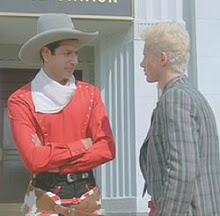
Being the former music critics that they are, the Boys can't stop at just that, though. This track is also obviously meant to make us think of the future of post-Soviet, rapidly capitalizing Russia. This theme is more obvious if you see the wildly imaginative video for the song, but you can hear it in the single too, in that gruffly fortified male chorus in the background, which seems ready to break into the Song of the Volga Boatman at the drop of a beaverskin hat.

In fact, although I've never read anything to confirm this, I've always thought that this particular single must have been inspired by Tony Kushner's Angels in America, even though the National Theatre's production of the play's second part ("Perestroika") in London almost certainly premiered after this was all laid down. But the way that this version of the song explicitly links western migration in the U.S., the fate of the former USSR, and the future of gay men's love is just too close to Kushner's conception of late twentieth-century history to shake off. As Kushner's Harper Pitt says in the penultimate scene of "Perestroika," "Nothing's lost forever. In this world, there is a kind of painful progress. Longing for what we've left behind, and dreaming ahead." That's exactly what Neil Tennant sounds like on this track: longing and dreaming, moving forward assuredly, hand in hand with his partner, while looking over his shoulder at all the loss in his wake.
In Longtime Companion, one of the first fictional films to treat the early years of the AIDS epidemic, there is a scene late in the film, set at a GMHC fundraiser, in which a string quartet plays a pseudo-classical arrangement of "Y.M.C.A." I've never liked that performance, because it's too tame, too sad, too resigned to "settling down"--which is, of course, something entirely different than "committing." Personally, I would have loved it if Mike Nichols had ended his miniseries version of Angels in America for HBO with this Pet Shop Boys track playing over the end titles. That would have sent me off in the right spirit. As HIV-positive Prior Walter says in the last lines of Kushner's epic, "You are all fabulous creatures, each and every one. And I bless you: More Life. The Great Work Begins."
 There they are: the Scott and Zelda of indie rock. God, they're both so pretty that you want it all to work out. It didn't, of course, but I at least wanted it to.
 Both these songs are about Cobain and Love's marriage, although the first one refers to it so obscurely that many people never realized it. Personally, I think "Wait/Wait/I got a new complaint/Forever in debt to your priceless advice" should have been a tipoff to some kind of domestic squabble, but admittedly "I want to eat your cancer when it turns black" is such a great line that it could tend to draw your attention away from the submerged subject at hand. Charles Cross, however, confirmed in Heavier than Heaven, his superb biography of Cobain, that even the title of the song referred to a present that had passed between the couple and was usually kept at their bedside.
 You can't get much clearer than "I'm married/Buried." Yet Cobain widens his scope to include critics of all varieties, not just his resented spouse. Yes, he sounds at points like a selfish junkie who feels besieged, but I think he's still self-aware enough at this point to know how whiny he may come off. Sometimes he can be hysterically funny in this exaggerated pose, What more can I say?/Everyone is gay being a classic case in point.