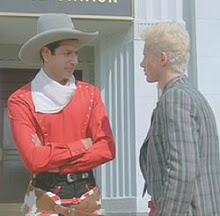
138. JAMES & BOBBY PURIFY, "Shake a Tail Feather"
Produced by Papa Don; written by Otha Hayes, Verlie Rice, & Andre Williams
Bell 669 1967 Billboard: # 25
139. QUEEN, "Fat Bottomed Girls"
Produced by Roy Thomas Baker and Queen; written by Brian May
Elektra 45541 1978 Billboard: # 24
140. SIR MIX-A-LOT, "Baby Got Back"
Produced by Rick Rubin; written by Sir Mix-a-Lot
Def American 18947 1992 Billboard: # 1
141. SISQO, "Thong Song"
Produced by Kevin Liles & Sisqo; written by Mark Anderson, Desmond Child, Tim Kelly,Joseph Lango, Bob Robinson, and Robi Rosa
Def Jam 562599 2000 Billboard: # 3
142. MYSTIKAL, "Shake Ya Ass"
Produced by Charles Temple; written by Chad Hugo, Michael Tyler, Pharrell Williams
Jive 42721 2000 Billboard: # 13
A third of a century of B.A. in pop. No, not Bad Attitude. Butt Awareness. I first encountered the term in the early 1990s, although obviously the phenomenon to which it refers predates that era by quite a few years. Still, the early 1990s do seem in retrospect like some sort of crossover moment for popular representations of the posterior--a moment of epistemological emergence, if you will.
Like the other singles listed here, James & Bobby Purify's "Shake a Tail Feather" easily made the Top 40, chiefly on its strength as a dance tune.

The song itself is undistinguished and yet surprisingly durable, with multiple renditions stretching from the Five Du-Tones' original 1963 version to the Cheetah Girls' 2006 cover for the soundtrack of Disney's
Chicken Little. The Purifys' version stands out, though, chiefly because of Papa Don's production. It's also worth pointing out, in light of the records considered below, that the reference to the butt here is more metaphorical than strictly anatomical. The singers seem quite happy to just dance in the club with the woman to whom they sing and don't necessarily require anything more from her.
Eleven years after the Purifys' tribute to dance club display, Queen received numerous protests from feminists for their own song's focus on that specific part of the female anatomy.
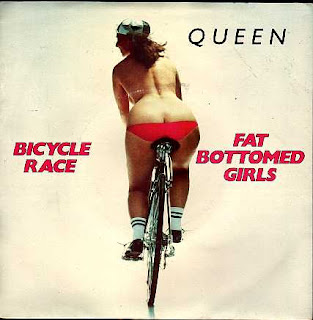
Obviously, the picture sleeve for their double-sided single didn't help, but I've always thought that this song got a bit of a bad rap. It's nowhere near as sexist as the Stones' "Some Girls," which received protests around the same time, and it does provide a bit of a useful corrective about body image. This is a song that exhorts men to broaden their horizons and accept women of all body types.
Ain't no beauty queens in this locality, the lyric goes, and it implies that that's a good thing, that widely circulated images of female beauty can desensitize consuming men to the charms of real-life women. If you take the song seriously (which I know may be a patently ridiculous thing to do). it is less about the culturewide objectification of women than about how heterosexual men do and don't visually appreciate the women that they know. Obviously, a man should not assess a woman wholly by her looks, but visual attraction is still an undeniable component of sexuality.
I suspect that this particular issue is more of a heterosexual (or if you insist heterosexist) phenomenon. This song is credited to Queen's lead guitarist Brian May, while its flipside, "Bicycle Race," is credited to the band's frontman Freddie Mercury. Nevertheless, Mercury delivers May's lyric with conviction, striking a blow for broadly conceived definitions of physical beauty everywhere.
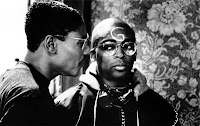
Some of the protest against Queen may have been racially tinged as well. Nine years later when Spike Lee made School Daze, his musical about a historically black college, he received some negative comment for featuring a big dance number baldly titled "Da Butt," but these comments were mostly of the "shande for the goyim" variety: how could you let the ofays see something like that? what will they think?
By the time Sir Mix-a-Lot's "Baby Got Back" came along in 1992, however, Butt Awareness had become an open sign of racial distinctiveness if not downright pride for some African Americans.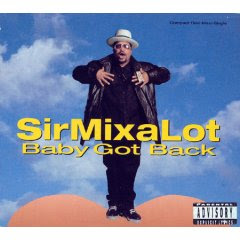 While it may be arguable whether Queen's single is a self-conscious critique of widely circulated images of female attractiveness, there is no doubt that Sir Mix-a-Lot has his preferred mass culture targets lined up in a row here: Cosmo (too thin), Playboy (too fake), rock videos (too lifeless). The shoutout to Florence Griffith Joyner seems to be a stab at racial bragging, and I've always read the "red beans and rice" line as an attempt by a Seattle-based African American male to self-consciously include his Caribbean sisters in this oddly anatomical pride parade.
In the end, there is a world of difference between "Baby Got Back" and Mix's 1994 mammary-themed follow-up single "Put 'Em on the Glass." The former song is about appreciating the variety of female beauty, while the latter is simply about a lazily undifferentiated interest in, as Mix grunts repeatedly at one point, "lungs." Nevertheless, it was this latter song that pointed the way to the future, to singles that were more graphic and anatomical than the Purifys' old dance stylings but less personalized than Queen's and Sir Mix-a-Lot's tributes. Viewed side by side, "Thong Song" and "Shake Ya Ass," both released in 2000, give us the twentyfirst century hiphop version of a butt-based madonna/whore complex. Sisqo, liberated from Dru Hill, is now apparently worshipping fulltime in the Temple of the Butt. He chants and keens his adoration but dares not approach his sacred vision--or presumably notice that there is a human being attached to it.
As for Mystikal, don't be fooled by his old school, Cab-Calloway-meets-James-Brown vibe. This song features a scenario that will become all too familiar in 21st century dance and hiphop tracks, a scene on which I've already commented in my brief treatment of crunk.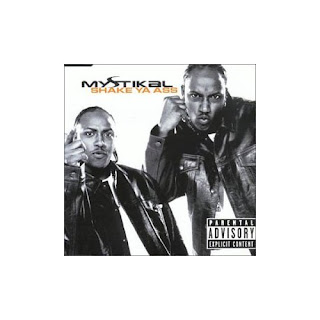 In this song, the singer tells the women to line up and move exactly as he tells them to. As in later "club" singles, the distinction between dance clubs and strip clubs seems blurred, and Mystikal's alternation of direct physical orders and promised material rewards make the epithet "ho" seem all too literal here. The line between appreciation and objectification is crossed in these two songs, more obviously in Mystikal's, more subtly in Sisqo's. The women in question are just body parts here, and the men singing about them don't seem to have even a perfunctory interest in the souls that animate them.
So, over four decades since the Five Du-Tones' original single, we have ended up here: with a variety of culturally provided images against which young men can physically measure the women that they actually know. I don't think that's progress, but it definitely qualifies as some kind of cultural evolution. (Some kind.)
Call me a nut, but I would really like to hearken back to one word in Brian May's easily dismissed lyric for "Fat Bottomed Girls": locality. Locality, specificity, individuality, soul--that's the core of beauty. That's what animates it, physically, romantically, or even purely sexually. And the more heterosexual men measure the varied real women that they know against the stylized icons that pop provides, the more they lose their grasp on their intoxicating souls.