Showing posts with label 1985. Show all posts

09 January 2009

Talking Vernacular Blues


876. GLENN FREY, "Smuggler's Blues"
Produced by Barry Beckett, Allan Blazek, & Glenn Frey; written by Glenn Frey & Jack Tempchin
MCA 53546 1985 Billboard: # 12

877. JOHNNY CASH, "Singing In Viet Nam Talking Blues"
Written by Johnny Cash
Columbia 45393 1971 Did not make pop charts

Oh Lord, he's talking Miami Vice again.

But seriously folks . . .

There's a traditional form in twentieth-century folk music called the "talking blues." The talking blues is not a "protest song" per se. It's more like a broadside, a song of indeterminate length in which words about recent events are more accompanied than set to music. The point of talking blues is to pass along information to the listeners, be it about the sinking of the Titanic, a strike at a shoe factory, or a day trip to Bear Mountain. Diehard folkies would probably suggest that there can't be such a thing as a pop talking blues, because the presumed slickness of pop would have to distract by definition from the self-conscious information drop of the words. Nevertheless, when Chuck D famously referred to rap "the CNN of black America," he as good as suggested that in the closing decades of the twentieth century, the talking blues had migrated into pop, into the undeniably polished tracks of contemporary hiphop.

But what about white Americans? One could argue that they don't need a muscial CNN because they already have the 24-hour news version, but no American above the age of eight would seriously suggest that what comes out of the mainstream news organizations is what we seriously need to know. Certainly in the pre-internet, not-yet-really-cable-ready 1980s, it wasn't. This is why, to complete their instruction about Reagan-era diplomacy in the Western hemisphere, many mainstream Americans needed . . . Miami Vice. The series was not just "anti-authority," as so many pieces of post-Vietnam American culture were. Episode after episode of the show, right down to the series finale, were premised in the idea that, no matter what the President might say, the War on Drugs would always suffer because its true success would undermine the supposed cause of fighting anti-communism.

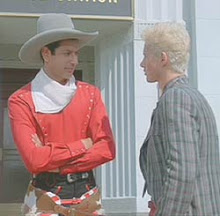
In no case was this more true than in the episode entitled "Smuggler's Blues." Glenn Frey, who also appeared as an actor in the episode playing a shady pilot, even wrote this song for it, and its verses punctuated the narrative transitions from location to location. The song isn't exactly a summary of the episode's actual plot, but it does borrows amply from it, right down to the punchline "It's the politics of contraband," which is uttered near the end of the episode by Don Johnson as the frequently sockless Sonny Crockett.

As in most talking blues, the music here is instantly forgettable. The words are the point, and even they contain no self-conscious flourishes that might draw attention away from the data they wish to impart. We are taken through a drug deal from start to finish but we are asked to see it in organizational terms. For a Reagan-era pop troubadour, drugs are not just recreation or a scourge on society. They're part of our foreign policy strategy for winning the Cold War. As Jackson Browne almost acknowledged when he rewrote "Cocaine" at a Christic Institute concert a few years later, this was the politically self-aware drug song that that more-respected singer-songwriter wished he had written.

Johnny Cash's "Singing in Viet Nam Talking Blues" is a more respected song than Frey's and a more obvious heir of the classic talking blues tradition so I won't belabor my analysis of it. But I would point out that Cash almost does the opposite in this song of what Frey would do in his song fourteen years later. Frey took something considered personal and recreational and connected to global politics, whereas Cash takes the most pressing geopolitical issue of his time and takes it down to the level of the personal. From the opening scene at the breakfast table, this is a song about a married couple who go on a trip. The purposefully understated, even labored folksiness of it is meant to disarm the listener. It reduces our trip through the war zone to a human level, which in turn makes the rain of shells even scarier. This is not the world of either Barry Sadler's or John Wayne's Green Berets. This is a scary environment in which the politics of the war seem ultimately irrelevant.

By the end Cash could shout, as almost no other country singer of his time could or would shout, for the "boys" to be brought home "IN PEACE!" and no one could mistake him for being pro-communist. Like Frey, he wasn't just preaching to a left-leaning proudly folkie choir. He was using the musical vernacular of his time, and spreading the news to a mediated crowd.

02 January 2009

Git Along, Lil Incarnations, Git Along


476. PRETENDERS, "Boots of Chinese Plastic"
Produced by Steve Bing and the Pretenders; written by Chrissie Hynde
2008 Did not make pop charts

477. TALKING HEADS, "Road to Nowhere"
Produced by Talking Heads; written by David Byrne, Chris Frantz, Jerry Harrison, and Tina Weymouth
1985 Did not make pop charts

Who says Asian philosophy has to be couched in Asian-derived music? Why not try your Buddhism deep-fried?

Chrissie Hynde performs what is definitely the coolest song ever written about reincarnation (not to mention the karmic implications of globalization) in a style that sounds as if the track was laid down in Sun Studios circa 1956. As in all her best songs, Hynde here is vulnerable and formidable all at once--which is why, to review, she is without question one of the four or five most breathtaking women in the world.

The Heads' track obviously starts out more stately, but it still ain't George Harrison. As usual with Heads songs, you can always depend on Frantz and Weymouth to keep the foundation of the track rolling and lively. Significantly, this is one of only two tracks on Little Creatures for which all four members of the band share songwriting credit. Here, Frantz and Weymouth earn their keep by nudging the Scottish-born Byrne to get in touch with his inner Rowdy Yates and turn the song into the liveliest cattle drive for inner peace ever attempted. And then he shrieks like a strung-out bald eagle on crank. Never has zen been this lively.

One theory of inner peace involves shutting oneself down and personal isolation, but these songs suggest two livelier, more social paths to enlightenment. And isn't it preferable for Anglo-Americans to cast their philosophical discoveries in their own vernacular rather than hearing them poach the music of other cultures? (Yes, Sting, I am calling you out.)

16 June 2008

We've All Been There


418. NICK LOWE AND HIS COWBOY OUTFIT, "I Knew The Bride (When She Used To Rock 'N' Roll)"
Produced by Huey Lewis; written by Nick Lowe
Columbia 05570 1985 Billboard: # 77

Or the groom for that matter. Good Lord, if you haven't lived through this song, you haven't lived. I even have one old friend who hurled herself against me in one All the Friends photo from my own wedding just to bear witness to this sort of feeling (I think). The lie is that rock and roll never ages; the truth is that rock and roll never forgets.

09 June 2008

Tom's Big Time

987. TOM WAITS, "Downtown Train"
Produced and written by Tom Waits
1985 Did not enter pop charts

The highest charting single by one of the greatest late twentieth-century U.S. songwriters--except it wasn't his recording of the song that charted.

Four years after Tom Waits' original recording of "Downtown Train" (released on the Burkeanly sublime album Rain Dogs), Rod Stewart's version made it to # 5 on the Billboard charts. The video for the song shows Rod in front of a number of trains, so he has apparently been in a subway station at least once, but seriously can you imagine Blondey Boy pining away after a woman he sees repeatedly on the G train? I'd buy into the dewy-eyed innocence of "Maggie May" before I'd believe that.

It's a shame really, because if Waits ever had a shot at the big time, it was with this song. It's probably his most conventional ballad, sweet but still gritty. Certainly, "Downtown Train" is not as weird as "Cemetery Polka" or as hopelessly pathetic as "Train Song." "Jersey Girl" is sweeter still, but even Bruce Springsteen didn't try to release his cover of that as a single. But the longing of this song is so beautiful, so perfect. It's almost medieval. And it's really not the same if anyone less shattered than the author himself sings it.

So, to answer your question: no, I don't like all covers. Some tracks are hard to improve on.

04 June 2008

When We All Had Secret Identities


63. SMITHS, "How Soon Is Now?"
Produced by Dale Buffin Griffin, John Porter, Roger Pusey, and the Smiths; written by the Smiths (Johnny Marr & Morrissey)
Sire 0-20284 1985 Did not make pop charts

For at least a decade, this song was the transatlantic anthem of disaffected white geek adolescence.

Then Love Spit Love remade it for the witch-chic film The Craft. That was okay, after a fashion, since the film was about four girls whose off-center power was unrecognized in their conformist high school. Plus Fairuza Balk (so tragically unnoticed for her precociously freaky turn as a pre-goth Dorothy Gale in Walter Murch's Return to Oz) actually looks like someone who's spent a lot of time listening to Smiths records.

Two years later, Aaron Spelling glommed onto the remake and used it for the main titles of Charmed, a TV series that was not about outcast witches but more about what Charlie's Angels would have been like if Bree, Jill, and Kelly had been able to teleport and see the future as well as handle a piece. Culturally, that particular appropriation finally kicked the song over the line from generalized longing to easy wish fulfillment. It had originally been a song about feeling as if you have power; it now became a song about actually having powers.

I'm pretty certain there are still a lot of teenagers out there who feel the way that the narrator of this song feels. (It's not a cliche, it's a truism, and there is nothing realer when you're living through it.) I hope they've found their own song to distill that feeling for them--but I hope that, like this song, it doesn't distill it too patly.