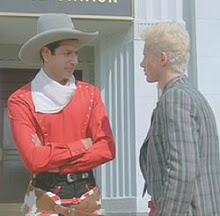
876. GLENN FREY, "Smuggler's Blues"
Produced by Barry Beckett, Allan Blazek, & Glenn Frey; written by Glenn Frey & Jack Tempchin
MCA 53546 1985 Billboard: # 12
877. JOHNNY CASH, "Singing In Viet Nam Talking Blues"
Written by Johnny Cash
Columbia 45393 1971 Did not make pop charts
Oh Lord, he's talking Miami Vice again.
But seriously folks . . .
There's a traditional form in twentieth-century folk music called the "talking blues." The talking blues is not a "protest song" per se. It's more like a broadside, a song of indeterminate length in which words about recent events are more accompanied than set to music. The point of talking blues is to pass along information to the listeners, be it about the sinking of the Titanic, a strike at a shoe factory, or a day trip to Bear Mountain. Diehard folkies would probably suggest that there can't be such a thing as a pop talking blues, because the presumed slickness of pop would have to distract by definition from the self-conscious information drop of the words. Nevertheless, when Chuck D famously referred to rap "the CNN of black America," he as good as suggested that in the closing decades of the twentieth century, the talking blues had migrated into pop, into the undeniably polished tracks of contemporary hiphop.
But what about white Americans? One could argue that they don't need a muscial CNN because they already have the 24-hour news version, but no American above the age of eight would seriously suggest that what comes out of the mainstream news organizations is what we seriously need to know. Certainly in the pre-internet, not-yet-really-cable-ready 1980s, it wasn't. This is why, to complete their instruction about Reagan-era diplomacy in the Western hemisphere, many mainstream Americans needed . . . Miami Vice. The series was not just "anti-authority," as so many pieces of post-Vietnam American culture were. Episode after episode of the show, right down to the series finale, were premised in the idea that, no matter what the President might say, the War on Drugs would always suffer because its true success would undermine the supposed cause of fighting anti-communism.
In no case was this more true than in the episode entitled "Smuggler's Blues."
 Glenn Frey, who also appeared as an actor in the episode playing a shady pilot, even wrote this song for it, and its verses punctuated the narrative transitions from location to location. The song isn't exactly a summary of the episode's actual plot, but it does borrows amply from it, right down to the punchline "It's the politics of contraband," which is uttered near the end of the episode by Don Johnson as the frequently sockless Sonny Crockett.
As in most talking blues, the music here is instantly forgettable. The words are the point, and even they contain no self-conscious flourishes that might draw attention away from the data they wish to impart. We are taken through a drug deal from start to finish but we are asked to see it in organizational terms. For a Reagan-era pop troubadour, drugs are not just recreation or a scourge on society. They're part of our foreign policy strategy for winning the Cold War. As Jackson Browne almost acknowledged when he rewrote "Cocaine" at a Christic Institute concert a few years later, this was the politically self-aware drug song that that more-respected singer-songwriter wished he had written.
Johnny Cash's "Singing in Viet Nam Talking Blues" is a more respected song than Frey's and a more obvious heir of the classic talking blues tradition so I won't belabor my analysis of it.
 But I would point out that Cash almost does the opposite in this song of what Frey would do in his song fourteen years later. Frey took something considered personal and recreational and connected to global politics, whereas Cash takes the most pressing geopolitical issue of his time and takes it down to the level of the personal. From the opening scene at the breakfast table, this is a song about a married couple who go on a trip. The purposefully understated, even labored folksiness of it is meant to disarm the listener. It reduces our trip through the war zone to a human level, which in turn makes the rain of shells even scarier. This is not the world of either Barry Sadler's or John Wayne's Green Berets. This is a scary environment in which the politics of the war seem ultimately irrelevant.
 By the end Cash could shout, as almost no other country singer of his time could or would shout, for the "boys" to be brought home "IN PEACE!" and no one could mistake him for being pro-communist. Like Frey, he wasn't just preaching to a left-leaning proudly folkie choir. He was using the musical vernacular of his time, and spreading the news to a mediated crowd.