254. RICHARD O'BRIEN et al., "Time Warp"
Produced by Richard Hartley; written by Richard O'Brien
1975 Did not make pop charts
As you may have guessed by this point, I frequently measure musical history as being B.R. and A.R.--Before the Ramones and After the Ramones. If I were just speaking culturally, I could use
The Rocky Horror Picture Show as a similar watershed, since I believe it marks an important milestone for a sizable segment of my own generation.

But
Rocky Horror is only a cultural milestone. It is not a musical milestone. The whole point of
Rocky Horror, both on stage and on screen, was its references back to an earlier mode of pop. Like the original stage version of
Grease (but not Randall Kleiser's eventual film adaptation),
Rocky Horror was part of a general deconstruction of the 1950s that went on in the 1970s. Like the original
Grease,
The Lords of Flatbush, The Wanderers, etc.,
Rocky Horror was about uncovering the simmering sexual conflicts that were under the mainstream culture of the postwar era.
But the key to this particular deconstruction (much of it innocuously filed under the greater heading of "rock and roll revival") was that it was innately
conservative. The music had to sound like the music of twenty years before so that the sexual undercurrents of that earlier era could be uncovered. From a purely musical standpoint, the only odd touch in a track like "Time Warp" are the theraminlike harmony vocals on the choruses. Those seem like a bit of an overstatement.

At least for this particular song, I think the sound of
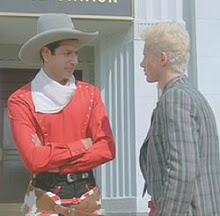
Rocky Horror was much less transgressive than its image. Listen to the soundtrack recording of this song, and it's just a lovely little dancetrack. But do you see how those people are dressed? If Brad and Janet just stepped out of a 1950s movie, the music wouldn't necessarily unsettle them but the thriftstore aesthetic of the guests' outfits would. Hippies popularized thrift stores, but punks and proto-punks turned them into essential supply depots for subcultural style. Call it postmodernism, call it bricolage, but the youths of the Sex Pistols' generation went into a thrift store to find familiar clothes that they could reassemble into an unfamiliar, slightly offputting ensemble.
Greil Marcus and others later called this detournage. During the 1970s, that's what
Rocky Horror did visually to the 1950s and the Ramones did aurally to the early 1960s. They pioneered the mashup in a pre-digital world. Eventually, the technology caught up with them,
 545. C. W. MCCALL, "Wolf Creek Pass"