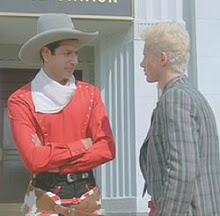
399. WALL OF VOODOO, "Mexican Radio"
Produced by Richard Mazda; written by Charles T. Gray, Marc Moreland, Joe Nanini, and Stan Ridgeway
IRS 9912 1983 Billboard: # 58
400. BUGGLES, "Video Killed The Radio Star"
Produced by the Buggles; written by Geoffrey Downes, Trevor Horn, Bruce Woolley
Island 49114 1979 Billboard: # 40
401. RAGE AGAINST THE MACHINE, "Guerrilla Radio"
Produced by Brendan O'Brien; written by Tom Morello and Brad Wilk
Epic 79270 1999 Billboard: # 69
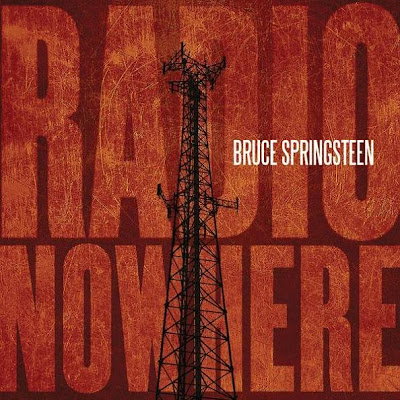
402. BRUCE SPRINGSTEEN, "Radio Nowhere"
Produced by Brendan O'Brien; written by Bruce Springsteen
2007 Billboard: # 75
[Hold on, gang, this is a long one, probably my longest yet. In a way, it's a history of the twentieth century.]
At the end of World War I, Dr, Frank Conrad seemed no different than so many other American radio geeks. Gugliemo Marconi had sent the first wireless signals in 1895, but those had been telegraphic, mere dots and dashes. Voice and sound transmission hadn't become feasible until 1906, and the war had pushed the new realm of wireless even farther both as a practical technology and as a popular fad. In 1919, Woodrow Wilson was the first president whose voice was transmitted by radio waves, but the president wasn't really the sort of person for whom most wireless geeks were listening. They listened for each other, especially at night when the transmissions could travel farther. Frank Conrad had a wireless set in his garage in Wilkinsburg, Pennsylvania, and used the call letters 8XK. When you heard another person's transmission, you wrote them and they sent you back a postcard with their call letters on it, which you added to your collection, the way 1990s teenagers added IM friends and 21st century geeks add Twitter followers.
But there was one thing that made Frank Conrad different from most wireless geeks: he worked for Westinghouse, and his employers were very interested in the commercial possibilities of this new popular technology.
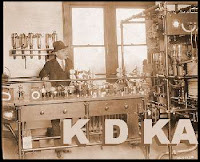
In the fall of 1920, Conrad's bosses encouraged him to turn 8XK into a more formal entity called KDKA-Pittsburgh. Most early radio stations were started in this way, by appliance companies, furniture companies, department stores, or newspapers, all entities that hoped to sell more hardware by turning out more attractive software that could only be enjoyed on it, a trick that Steve Jobs and Apple would reinvent three-quarters of a century later by opening iTunes. KDKA was only on for a few hours every day (in the evenings, of course), but a loose schedule of its programming was printed in the local newspaper, so that early adopters of the new technology could know when to tune in. The station still operated out of Conrad's garage, though. Even when it transmitted live election returns that November, they only had a staff of four. Nevertheless, Conrad was allegedly the man who invented the term "broadcasting," and most media scholars consider him a key transitional figure in the U.S. between the amateur and professional eras of radio history.
Conrad is also the first person who played records on the radio on something like a predictable schedule. He played classical music--jazz would have been unthinkable and rock didn't exist yet--but still he was, in a way, the first American "disc jockey." For almost three decades after Conrad, as radio went network and therefore national, playing records on the radio remained a mostly local phenomenon. Because of protests from the American Federation of Musicians, any network program that wanted to air current music essentially had to use a live band to do so, which is one of the reasons why so many swing bands either got shows of their own or supporting gigs on variety shows fronted by singers or comedians.
Nevertheless, even more than movies or recording, the arrival of network radio ushered in the so-called Golden Age of Mass Media,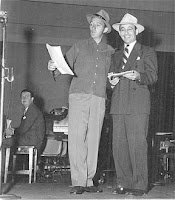 a period from about 1933 through 1970 during which a definable, mediated mainstream almost exclusively dominated American popular culture. Radio provided the first opportunity for millions of people in vastly different situations throughout the U.S. to be listening to the same sounds at the same time. That, in turn, when combined with the fact that there were only two or three networks to choose from, ensured that the same songs would keep popping up again and again in most people's surroundings, something that had been far more difficult to ensure at the beginning of the century, when sheet music rather than radio had been the dominant means of mass cultural transmission.
What made early American broadcasting unique in its time, however, was that it was a wholly market-driven phenomenon. In Western cultures as seemingly separated as the U.K. and Germany, the state ran the broadcasting and essentially decided what was good for you, whether you wanted to hear it or not. In the U.S., the networks--and more essentially the program-specific sponsors who really ran radio in a way that they would not come to run television--had to guess what you wanted to hear.
Thus began the great game of twentieth-century mass culture: is what we think they want to buy what they really want to buy? If it isn't, can we convince them that it's what they want to buy? As the movies had learned a few decades before radio, mass producing widely salable cultural product is much harder than it looks. If a cultural product is going to succeed with a truly mass audience, it can't just be bland and nonthreatening. It has to be both easily assimiliable and infinitely variable, both known and new at one and the same time.
But no product, no matter how well calculated its launch into the market may be, ever succeeds universally. Consequently, every moment of seeming mass cultural dominance produces its own kind of counterprogramming--a mass counterculture if you must; a niche market if you're feeling timid.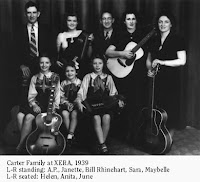 The first widely reported instance of these were the so-called "border-blaster" or "X" stations that broadcast into the U.S. from the northern regions of Mexico, some of them at as much as a million watts of power. In a pre-internet age, broadcasting from a physical plant outside the U.S. was the best way to escape U.S. regulations while still enjoying the advantages of access to a broad crossection of U.S. consumers. Ads on border-blaster stations were not subject to FCC or Better Business Bureau scrutiny and could claim whatever they wanted. The music on such stations was whatever would attract attention. Given the stations' position within the market, broadcasting the hit parade would have been counterproductive. Consequently, the X stations broadcast the things that people wanted to hear that were not on the hit parade, most notably the Carter Family, whose dour country music was not quite the kind of homespun sound that the Grand Ole Opry wanted to carry when it went national.
Fast forward four or five decades.  Television has replaced radio as the dominant form of broadcasting for variety or narrative programming, AM radio has played Billboard's Top 40 on a regular basis for at least two decades, FM radio now exists to supplement AM by providing more marginally popular music, and Wall of Voodoo (as FM a band as you could find in 1982) suddenly has a mainstream hit with "Mexican Radio," a perhaps overly exoticized paean to the old border-blaster stations. "Mexican Radio" was one of a number of songs from this period that looked back on radio nostalgically, including such less memorable works as the Ramones' "Rock and Roll Radio," Queen's "Radio Gaga," and Starship's "We Built This City."
These songs were the products of a fairly odd moment in radio history. In the early 1980s, FM stations were being rapidly swallowed up by media conglomerates like Infinity and ClearChannel, and their d.j.s' playlists were being more tightly constricted than they had been during the Nixon, Ford, and Carter years. But even though these acts were nostalgic for the freeform days of early FM, some of the songs they wrote seemed even more nostalgic for the old days of AM radio. The Ramones' and Queen's songs certainly did, even if Starship's was probably a tribute to the late 1960s programming on San Francisco's KFOG. Wall of Voodoo may have half-jokingly been espousing a true radio alternative, but it's worth remembering that it had been the station XERB, located in Rosarito Beach, Baja, that had originally launched Wolfman Jack, maybe the most universally recognized Top 40 d.j. of the 1950s and 1960s. In other words, some if not all of these acts seemed to be quite happy to listen to pop music. They just wanted to hear a different kind of pop than their radios were currently receiving.
An even stranger form of broadcasting nostalgia was evident in the most famous British contribution to this subgenre, the Buggles' "Video Killed the Radio Star,"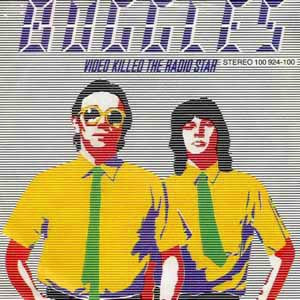 whose status as instant trivia question answer has long obscured how odd a song it really is. Not only is this song not nostalgic for 1970s FM, it's not even nostalgic for rock and roll. Instead, it looks back longingly on freshly composed symphonies played on the Beeb back in 1952. An anti-technology song played as technologically as any other late 1970s British New Wave track, "Video Killed the Radio Star" feels like a musicological equivalent of "The king is dead! Long live the king!" or, even more, like the sort of salute in passing that characterized the so-called "Vanishing American" depictions of Native Americans in the late nineteenth and early twentieth centuries.
Given the fact that the Buggles were British, it's worth asking whether they were seriously (seriously?) nostalgic for the good old days of state-controlled radio during which listeners got a steady diet of what was good for them. During the late 1960s, the BBC had not broken rock and roll bands like the Beatles, the Rolling Stones, or the Who. The last band in particular had benefited from the so-called "pirate radio" stations that had broadcast just outside British waters and played the songs that the Beeb had been too genteel to endorse quickly. Pirate radio's relationship to state-run radio in England was very different than the border-blasters' relation to commercial radio in the U.S. The pirate stations were challenging a music selection that they saw as censorious and providing a self-conscious alternative to it--from which they did, admittedly, hope to make a profit. During the years between the premieres of the Who and the Buggles, British pirate stations broke a great many punk bands, even as BBC2 loosened up a little and managed to offer a wider range of music for its listeners, particularly via the legendary Peel Sessions.
By the 1990s, it was American commercial radio that seemed to demand a self-conscious alternative, which is exactly what "Guerrilla Radio" is supposed to be about.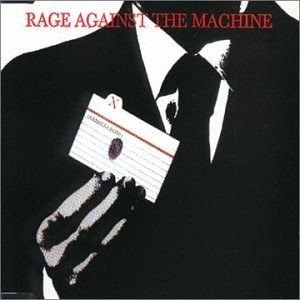 By then, FM had become almost fully corporate, with specific entities owning up to five stations in every market, each carefully shaving off a different sliver of musical interest: classic rock vs. alternative; r&b vs. hiphop, etc. Starting with the rise of demographic analysis in marketing during the 1970s, record companies and broadcasters had learned that more money could be made, not by selling to a theoretical aggregate as media businesses had done throughout the midcentury, but rather by selling to specifically tailored tastes. With these new, more narrowcasted FM stations, you could turn on the radio and hear mostly just what you wanted to hear, with few songs that would disturb your individualized taste. "No rap, no metal" as I heard one repackaged Boston station put it at some point in the early 1990s, which of course caused me to promptly remove it from the quickselect buttons on our car radio.
If you listen closely to Tom Morello's lyrics, however, "Guerilla Radio" doesn't really want to challenge this state of affairs all that much. It just wants to supplement it. Rather typically for a decade in which the most mainstream pop music was labelled "alternative," this song premises cherished personal taste on opposition. What the singer wants to hear is not the sort of freeform radio that had been available on early FM stations but rather an underground station that only plays stuff that would never show up on any of the corporate-owned stations that currently dominate his dial. He doesn't want nicheless radio--he wants radio that recognizes his niche.
The decade since "Guerrilla Radio" was released has seen nothing but greater and greater specialization of music media along these lines. Both radio and records are now more consumer-driven than at any time in their history, and the mass audience for pop has not been this irrelevant to the music industry since Frank Conrad first started fiddling around with a wireless. Radio has also become mostly irrelevant to popular music, because so many Americans under the age of 50 now carry their favorite, private radio station in their pocket, with white earbuds to stuff in their ears like so much cotton to keep out any nonpreapproved sounds that might bleed in. Listeners buy singles now, not albums, and services like Pandora offer ever more sophisticated ways for them to find music that they don't know that doesn't sound too different from the music that they do.
Less relevant as a market force but even more interesting symbolically, satellite radio has taken this process even farther and turned broadcasting into narrowcasting on an unprecedented level. Now you can listen to radio stations in your car that not only offer no rap or metal but no music not composed by a single artist. "Every performer's dream," Bruce Springsteen has quipped in concert, "Turn on the radio anytime, you always hear one of your songs."
But Springsteen, we should note, is a friend and sometime collaborator of Tom Morello, as well as a host of other acts that don't exactly show up too often on the Billboard charts. He's never said as much, but I suspect that "Radio Nowhere," the lead track and single off his 2007 album Magic, reflects his ambivalence about All Bruce All the Time radio. It's a very typical song for him, addressed to his audience and even repeating a line in the chorus (Is there anybody alive out there?) that he has used throughout his career to get sedentary audiences up off their feet. As in so many Springsteen songs, the narrator is someone driving at night, flipping through the dial like the narrator of the Modern Lovers' "Roadrunner," trying to find fresh sounds to fill his ears. Do these sounds have to be exotic, all worldmusicky and foreign like the ones that may have turned on Wall of Voodoo? Probably not, given the fact that the song's guitar riff is an obvious steal from Tommy Tutone's "867-5309 (Jenny Jenny)," as poppy and nonalternative a song as one could imagine.
What does the narrator want to hear? Pentecostal preachers? Sure. Excessively localized stations coming in at night from New Orleans and Memphis like the ones that inspired a Canadian boy like Robbie Robertson to pick up an instrument? Absolutely. Silly new pop songs? Why not? He wants all of it. A million different voices speaking in tongues. He wants something that hasn't been tailored to him, that he didn't specifically choose because it might be like something he already knew. This was the real Spirit of Radio, the one that Rush could never really dream of, the one that seems pert near dead in our current, young century. At its best (at night), radio seemed like a limitless ocean that could take you to faraway places and cultures you never thought you'd visit, if you'd only let go and stop hugging the shore near the ports of familiar stations.
It's silly to be nostalgic for an era, let alone a medium. Still, if we now all surf the internet rather than the radio dial, I hope that Google remains a little imperfect. To grow culturally, we don't need what we know we want. We don't even need exotic alternatives to what we know and dislike, cool music sites that friends recommend to us because of the things that they dis and refuse to play. Those are just "alternative" arms of capitalist marketing, and they have been for at least four decades now. No, what we need to grow culturally is the random: the voice in the night of a friend we haven't met yet; the odd sounds that claim to be some kind of music, but to which we don't yet know how to listen.